MCP Server: The Future of AI Integration & Tool Access
Published on January 6, 2026 • 10 min read
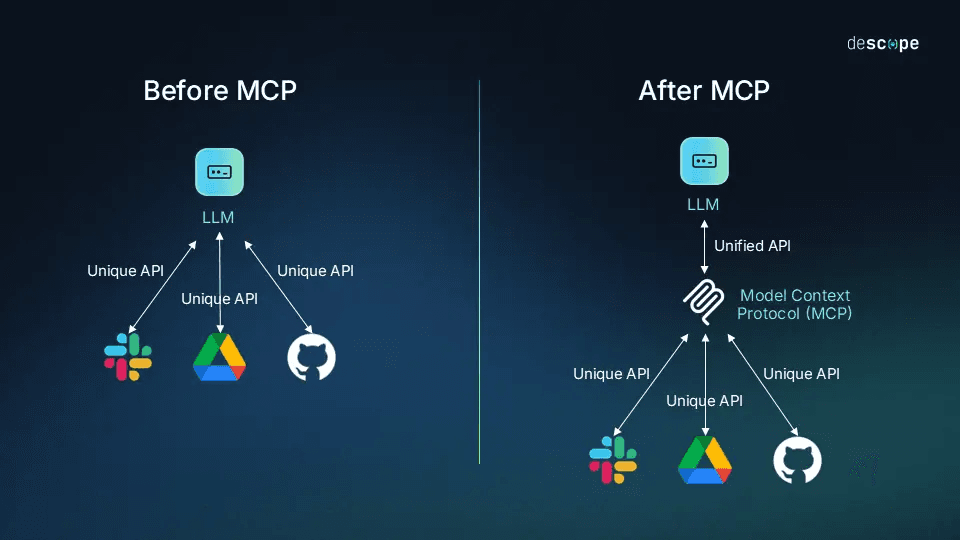
The rise of AI agents and advanced language models has created a critical infrastructure gap: how do AI systems access tools, data sources, and external resources? Enter the Model Context Protocol (MCP) server—a revolutionary approach to AI tool integration that's transforming how we build intelligent applications.
What is an MCP Server?
An MCP server acts as a specialized interface that connects AI models to external tools and data sources. It provides structured, typed access to resources while maintaining security and context awareness. Unlike traditional API wrappers, MCP servers are designed specifically for AI agents that need to make decisions based on complex, multimodal data.
Core Architecture Components
Understanding MCP server architecture requires looking at three interconnected layers:
- Resource Layer: Handles data access, file systems, databases, and API integrations. MCP servers can expose structured data formats that AI models can query and process efficiently.
- Tool Layer: Exposes callable functions with clear parameters, return types, and documentation. This enables AI models to perform actions like sending emails, updating records, or executing code safely.
- Context Layer: Manages conversation history, session state, and semantic understanding. This ensures AI responses remain coherent across multiple interactions and tools.
Why MCP Servers Matter in 2026
The landscape of AI development has shifted dramatically. We've moved from simple chatbots to autonomous agents capable of complex task execution. MCP servers address several critical challenges:
- Standardization: Provides a unified protocol for tool access across different AI platforms and frameworks.
- Security: Enforces fine-grained access controls and data protection policies at the server level.
- Observability: Offers detailed logging and metrics for debugging AI behavior and tool performance.
- Extensibility: Makes it easy to add new tools and resources without modifying core AI models.
Building Your First MCP Server
Getting started with MCP servers is straightforward. Here's a simplified implementation approach:
Pro Tip: Use MCP-Ready Frameworks
Don't build from scratch. Leverage existing frameworks and libraries designed specifically for MCP server development. These tools handle the complex protocol details, security, and serialization for you.
mcp-frameworkOfficial reference implementation with TypeScript support
mcp-server-sdkPlugin-based architecture for extending functionality
mcp-authSecurity middleware for authentication and authorization
Advanced Use Cases
MCP servers enable powerful AI capabilities across various domains:
- Autonomous Data Analysis: AI agents can query databases, generate SQL, and present insights with natural language.
- Multi-Tool Coordination: Complex workflows involving multiple tools with dependencies and error handling.
- Real-Time Integration: Access to live data sources like APIs, IoT devices, and streaming services.
- Code Execution: Safe, sandboxed environments for AI-generated code execution and testing.
Best Practices for MCP Server Development
To build effective MCP servers, follow these established guidelines:
- Document Everything: Tools must have clear descriptions, parameters, and expected behaviors.
- Implement Timeout Handling: Prevent indefinite blocking when external services are unresponsive.
- Add Retry Logic: Handle transient failures gracefully with exponential backoff.
- Optimize Response Times: AI agents prefer fast, responsive tools with structured outputs.
- Implement Caching: Cache frequently accessed data to reduce load on downstream services.
Conclusion: The AI Infrastructure Revolution
MCP servers represent a fundamental shift in how we build and integrate AI systems. By providing a standardized, secure, and extensible framework for tool access, they enable the next generation of intelligent applications. Whether you're building an AI-powered analytics platform, a content generation system, or an autonomous agent, MCP servers should be at the core of your architecture.
Ready to explore the future of AI integration? Read more about AI development and tools.